A short, useful timeline
The main historical periods, explained simply
These turning points help you identify what belongs to which era. Dates refer to major events or building phases, not to every surviving wall.
01913
An early government precinct
According to the official history, Abd al-Rahman III ordered the Dar al-Imara government complex on the southern edge of medieval Seville. This marks the key starting point for the Alcázar’s recorded development.
RememberThe site began as a centre of political power, not as a tourist palace.
0211th–12th centuries
An evolving Islamic royal complex
Successive rulers enlarged and changed the fortified palace area. Seville’s Islamic history included different dynasties, so the surviving complex should not be attributed to one ruler or one century.
Look forEnclosed courtyards, controlled entrances and the importance of water in palace design.
031248
Seville passes to Castilian rule
Ferdinand III took Seville in 1248. The palace precinct continued to serve ruling elites rather than being abandoned, and new Christian royal spaces were added.
Why it mattersA political change did not erase earlier architectural traditions.
0413th century
Alfonso X and the Gothic Palace
The Gothic Palace is associated with Alfonso X. Its more monumental rooms offer a different visual language from the intimate, highly patterned interiors that visitors see elsewhere.
CompareThe scale of the Gothic rooms with the elaborate surfaces of the Mudéjar Palace.
0514th century
Pedro I builds his Mudéjar Palace
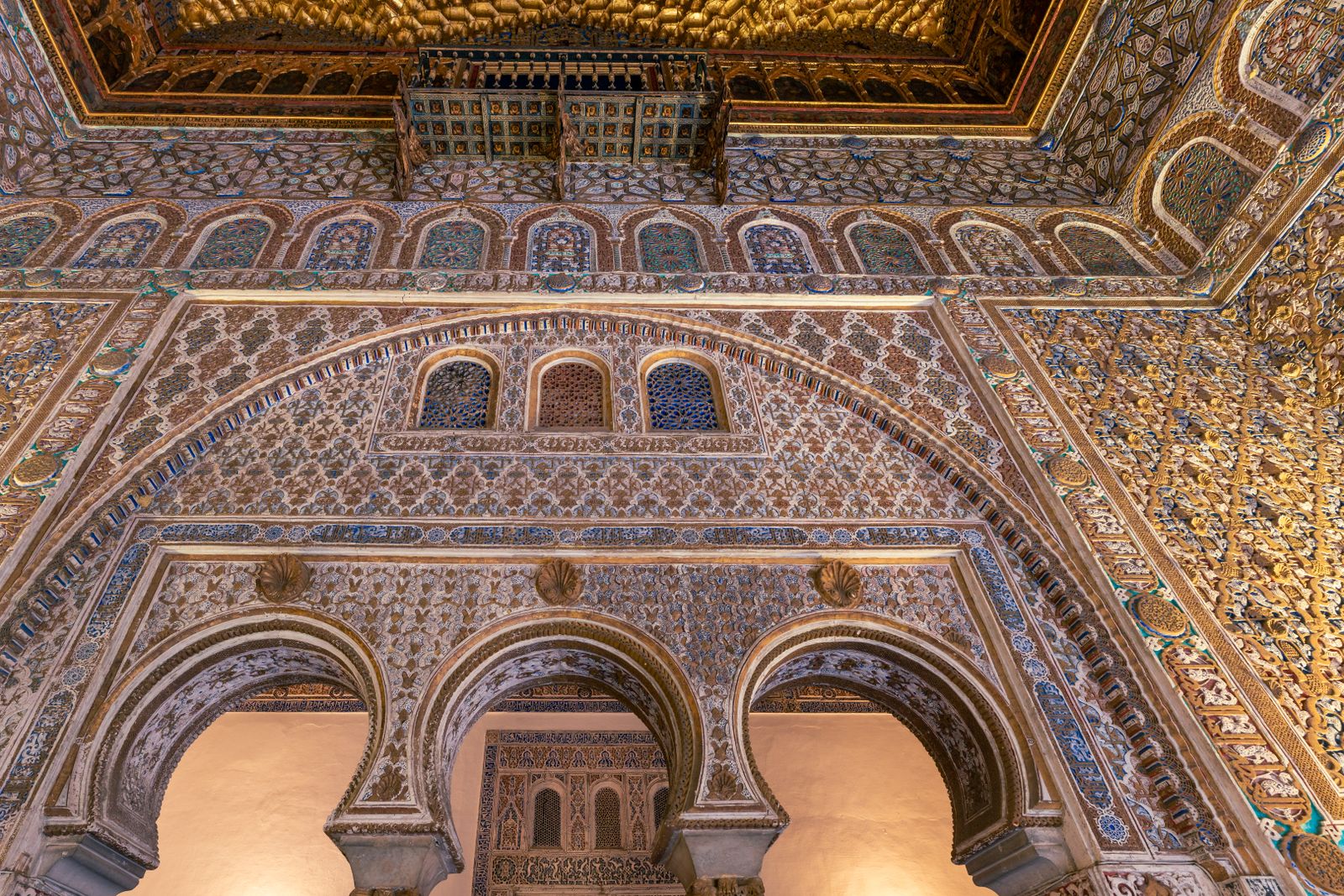
Pedro I commissioned the palace most closely associated with the modern Alcázar. Artisans used carved plaster, geometric tiles, timber ceilings and Arabic inscriptions to create a striking Christian royal residence.
Do not missThe Patio de las Doncellas and the Salón de Embajadores (Hall of Ambassadors).
0615th–16th centuries
A palace changing with the Renaissance
Later rulers continued adapting rooms, decoration and gardens. Rather than being a single preserved medieval building, the Alcázar remained useful to a changing court.
NoticeOlder Islamic-influenced details alongside later additions and changing garden styles.
0716th century onward
Seville’s connection with Atlantic trade
The Alcázar also formed part of the administrative story of Spanish expansion across the Atlantic. The Casa de Contratación operated at the palace, linking its historic rooms with voyages, trade and colonial administration.
UnderstandThe site tells a political and global history as well as an architectural one.
081987–today
World Heritage status and continued use
UNESCO inscribed the Alcázar together with Seville Cathedral and the Archivo de Indias in 1987. The palace remains a place where history, heritage protection and royal use overlap.
Plan aheadHeritage status does not mean every room or garden area is open every day.